Specialist Aston Martin finance, arranged through a panel of specialist lenders for deals of any size. We work across the full Aston Martin range, from current model-year cars to limited-build halo models and classics.
Typical Aston Martin list prices range from £140k to £3m+
Aston Martin finance is specialist car finance arranged against an Aston Martin Lagonda car, placed by Hypercar Finance through a panel of specialist lenders. The Vantage lists from £165,000, the DB12 from £185,000, the DBX 707 from £189,000 and the DBS Superleggera from £225,000, so the structure matters more than the sticker.
The Aston Martin finance deals we arrange run across that range, up to the Valkyrie at £2.5m, and back through the used and classic market to the DB4, DB5 and DB6. Each of our four Aston Martin product pages carries a payment deck computed at render time, so the numbers follow your deposit and term rather than sitting fixed in a paragraph.
Hypercar Finance is an independent credit broker and is not authorised or regulated by the Financial Conduct Authority. We do not arrange regulated consumer credit. Every agreement here is unregulated commercial finance for a business, a company director or a high net worth buyer.
What it costs to finance an Aston Martin
What an Aston Martin costs to fund is set by the price, the deposit, the term and the balloon deferred to the end. On a DB12 at £185,000, a 20 per cent deposit with a 50 per cent balloon leaves under a third of the car to amortise across the term; remove the balloon and the whole balance amortises. That single decision moves the figure further than any realistic difference in rate.
Deposits on Aston Martin finance run 15 to 30 per cent, terms 36 to 60 months, and our indicative band is 8.9 to 9.9 per cent on current cars. A part exchange counts towards the deposit exactly as cash does, and we settle any outstanding agreement on it within the same transaction.
We compute monthly payments rather than print them, because a printed one ages the moment the deposit changes. The calculator on this page runs your own numbers against any Aston Martin price, and the hire purchase, lease purchase, PCP and equity release pages each carry a computed deck. Aston Martin Financial Services offers the captive product through the dealer on current stock, and where it is the better answer we will say so.
Aston Martin finance deals and the four structures we write
Four structures cover every Aston Martin finance deal, and they differ at the end of the term rather than at the start. Hire purchase spreads the full balance with no balloon and passes title with the final payment. It is the usual answer on a DBX 707 held through a limited company, where the car is a working asset and the director wants it owned outright at a defined date.
Lease purchase defers an agreed sum to a final balloon pegged to the projected residual, which lowers the amount financed across the term. It is the structure we place most often on a DB12 and a Vantage, and at the end you settle the balloon, refinance it, or part exchange the car and roll any equity forward.
Personal contract purchase fixes a Guaranteed Minimum Future Value at the outset, so the lender rather than the buyer carries the residual forecast. It suits the current DB12, Vantage and DBX 707, where there is enough comparable data for a lender to commit to a number.
Equity release refinances an Aston Martin already owned, releasing the difference between an agreed valuation and any outstanding balance as cash. It is the structure that does the most work on a DB4, DB5 or DB6, on a One-77 or V12 Zagato, and on a Valkyrie, all of which sit well clear of their original invoice. Our finance guides compare the four in full.
Which Aston Martin models we fund, from Vantage to Valkyrie
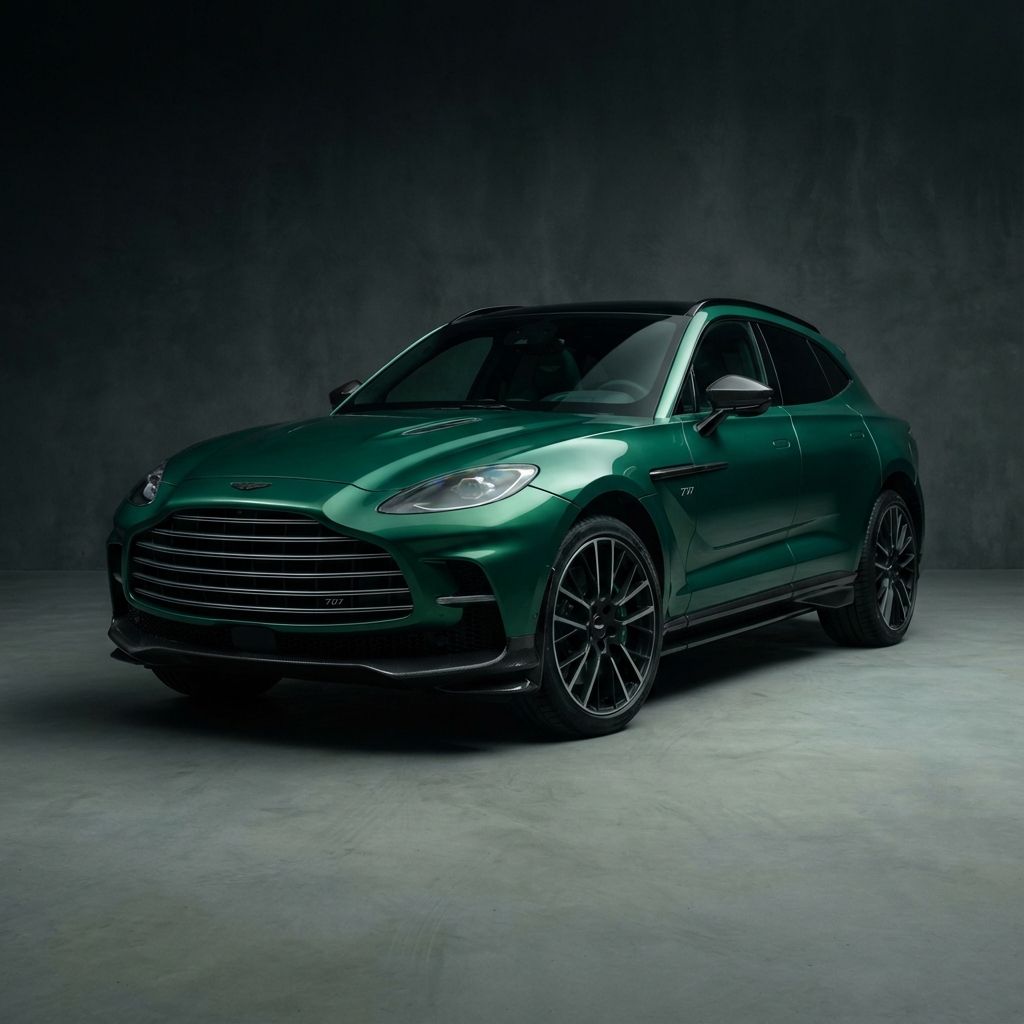
The Aston Martin Vantage is the two-seat sports car, a 656 bhp twin-turbo V8 from £165,000 and the most compact car in the range, sold as a coupe and as the Vantage Roadster. The DB12 is the Super Tourer above it at £185,000, with 671 bhp from a recalibrated version of the same V8 and a Volante convertible alongside the coupe. The Aston Martin DBX 707 is the performance SUV at £189,000, and it is the car most often funded through a business.
The DBS Superleggera at £225,000 closed the previous flagship line and now trades as a defined-supply used car, which is a stronger position for a lender than open stock. The Valkyrie, the road-legal Le Mans Hypercar developed with Red Bull Advanced Technologies, lists at £2.5m and is funded on valuation rather than list. The Valhalla sits behind it as the mid-engined series car.
The classic side is where Aston Martin Works at Newport Pagnell still shapes the market. We arrange finance against the DB4, DB4 GT, DB5, DB6 and DB7, the wedge-era V8 Vantage, the Aston Martin Vanquish and Vanquish S, the DB9 and the Rapide, and the limited One-77, Vulcan and V12 Zagato. Each is underwritten on the individual car, its history file and its certification rather than on any model average.
Gaydon residuals and what a lender will lend against
Aston Martin Lagonda has built at Gaydon in Warwickshire since 2003, with the heritage and restoration division at Newport Pagnell, and the residual picture divides cleanly. The DB12, Vantage and DBX 707 have enough transaction data for a lender to price a balloon quickly. A DB4 GT or a One-77 has almost none, so the lender values the individual car and wants the evidence in front of it.
Market history matters here more than most. DB5 values traded modestly through the 1970s and 1980s and have climbed a long way since, and the wedge-era V8 Vantage followed the same shape two decades later. That is history rather than a forecast, and it is the pattern that supports a larger deferred figure on a classic Aston than a mainstream residual table would allow.
What lifts loan to value is documentary. Main dealer or specialist service history, an Aston Martin Works heritage certificate on an older car, original specification against the build record, genuine mileage and a clean provenance check all move the number. On a restored car, invoices and photographs of the work matter as much as the finished result.
Buying through a dealer, at auction, or privately
Franchised Aston Martin dealers and independent specialists are the simplest route. There is an invoice, a warranty position, a documented inspection on approved used stock, and the lender pays the dealer directly on the day. The captive product is usually presented at the same point, and there is no obligation to take it.
A private sale is usually cheaper and always slower, because the lender must verify title, confirm nothing is outstanding against the car and check the V5C before funds move. We begin that work the day a price is agreed. Aston Martin car finance on pre-owned cars bought privately clears at the same rates as dealer stock, but buyers should price in those extra few days.
Auction is where much of the DB-series market trades. You are committed at the fall of the hammer and the balance plus the buyer's premium is normally due inside seven days, so the facility has to be in place before the sale. We confirm in writing whether the lender funds the hammer price or the all-in figure, so the ceiling you bid to is a real number.
Aston Martin finance questions buyers ask
Can you get an Aston Martin on finance? Yes. We arrange car finance on new, used and classic Aston Martin cars through a panel of specialist lenders, usually with a decision inside 48 hours. The asset and your commercial position carry the underwriting rather than a consumer affordability test.
Is Aston Martin in financial difficulty? Aston Martin Lagonda is a publicly listed company and has raised capital several times since 2018. That is a corporate question rather than an asset one. Lenders fund the specific car in front of them using current market evidence, and demand for the DB12, Vantage, DBX 707 and the classic DB cars is assessed independently of the parent company's quarterly results.
Does Aston Martin offer its own finance? Yes, through Aston Martin Financial Services alongside the dealer on current cars. We are the independent alternative, and the gap is widest on used, classic and limited-build cars, and on any car being refinanced rather than bought.
What is the 50 per cent rule for car finance? It is voluntary termination under the Consumer Credit Act and applies only to regulated consumer agreements. Everything we arrange is unregulated commercial finance, so it does not apply, and early settlement terms are agreed with the lender at the outset.